WatchIQ

Omega
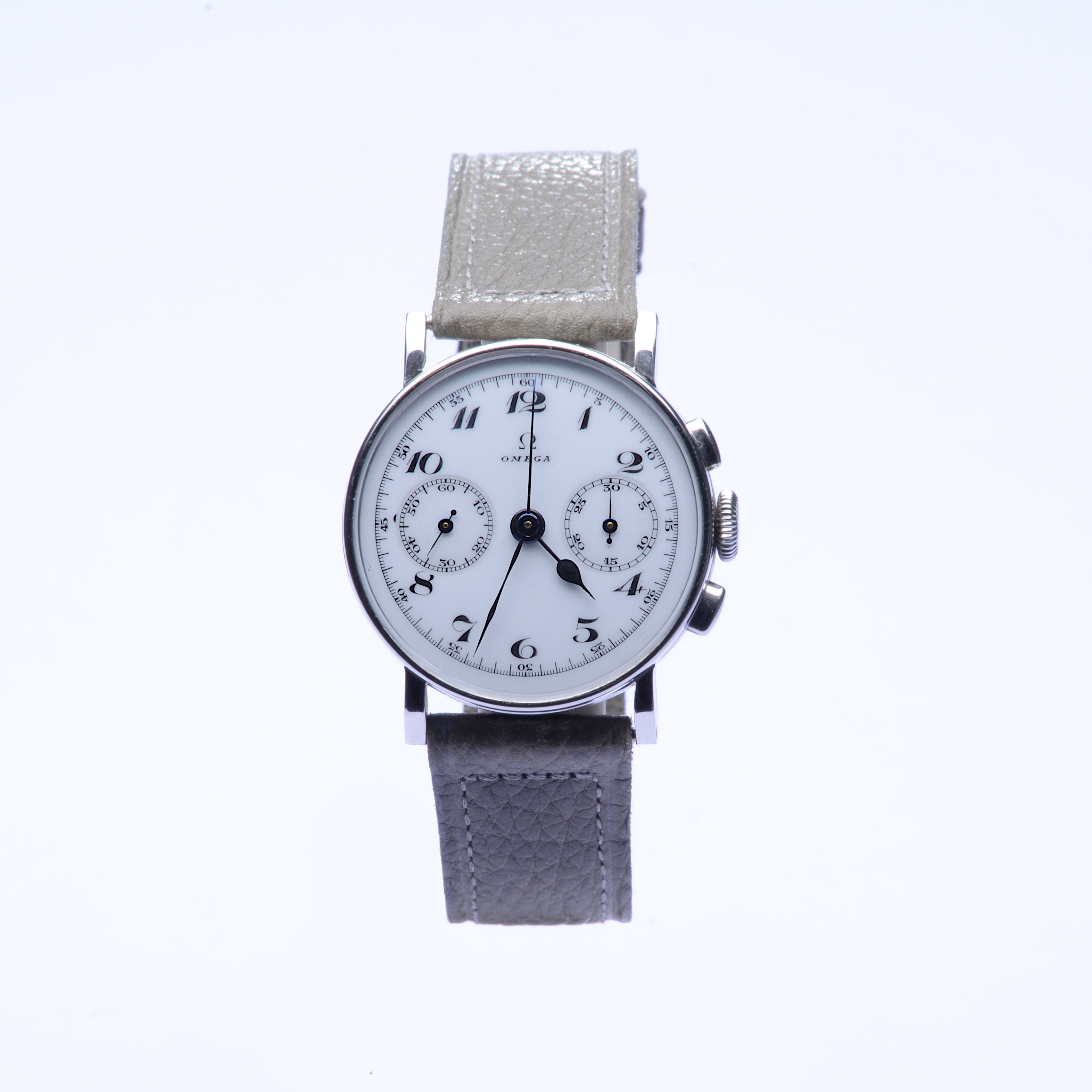
Omega Vintage Monopusher Chronograph 33.3
Market Estimate
~$18,500
Specifications
Market Range
Omega
Omega Vintage Monopusher Chronograph 33.3
Market Estimate ~ $18,500
Market Range
Specifications
Executive Overview
The Omega Vintage Monopusher Chronograph, specifically those powered by the legendary Calibre 33.3, represents one of the most significant chapters in the brand's pre-Speedmaster history. This particular specimen is a rare survivor from the late 1930s, an era defined by tool watches designed for professional, military, and scientific applications. What distinguishes this model is the 'monopusher' configuration, where a single actuator integrated into the crown or positioned as a single button handles the start, stop, and reset functions of the chronograph. This specific example features a multi-scale dial, incorporating both a tachymeter for speed and a telemeter for distance, rendered in a sophisticated tri-color printing style. Collectors prize these early chronographs not only for their mechanical purity but for their larger-than-average case sizes for the period, often measuring between 37mm and 38mm, which affords them a contemporary presence on the wrist. As a precursor to the modern professional chronograph, this model serves as a bridge between the pocket watches of the early 20th century and the high-performance wrist instruments that would eventually go to the moon. Its existence is a testament to Omega's early dominance in precision timing and its commitment to functional elegance.
Technical Architecture
At the heart of this timepiece is the historic Calibre 33.3, a movement originally developed by Lemania (as the 15CH) before being adopted and refined by Omega. This caliber is widely regarded as one of the finest manual-wind chronograph movements ever mass-produced, featuring a column-wheel mechanism that ensures smooth and precise operation of the timing functions. The case is constructed from 'Staybrite' stainless steel, a high-grade alloy of the era known for its corrosion resistance and ability to maintain a high polish. The dial architecture is particularly complex, featuring a 'sector' layout with Arabic numerals and a snail-style tachymeter scale in the center. The dual sub-dials at 12 and 6 o’clock provide a vertical symmetry that is distinct from the more common horizontal layouts seen in later 321 or 861 calibers. Protected by a high-domed hesalyte crystal, the dial displays a beautiful patina consistent with its age. The lugs are typically fixed or feature traditional spring bars depending on the specific reference, supporting a tapered leather strap that emphasizes its military-adjacent heritage. The monopusher system requires a sophisticated lever arrangement within the movement to cycle through the three-stage chronograph sequence using a single point of contact, a feat of micro-engineering that remains a favorite among horological purists.
Historical Context
Introduced in the 1930s, the Omega 33.3 series arrived at a pivotal moment in horological history when the wristwatch was finally displacing the pocket watch as the primary tool for professionals. Before the Speedmaster became the definitive Omega chronograph in 1957, the 33.3 was the brand's flagship complicated timepiece. These watches were often issued to pilots, military officers, and scientists who required precise interval timing in the field. The multi-scale dials were not merely decorative; the telemeter scale was used to calculate the distance of artillery fire by measuring the time between the flash of a muzzle and the sound of the explosion, while the tachymeter allowed for the calculation of speed over a known distance. This model's production coincided with the rise of Art Deco influence, visible in the balanced dial proportions and the elegant font of the numerals. Over the decades, many of these watches were lost to the rigors of service or the ravages of time, making well-preserved examples with original dials—like the one pictured—extraordinarily scarce. It represents the foundation upon which Omega built its reputation as the official timekeeper of the Olympic Games and, eventually, NASA.
Market Intelligence
The market for vintage Omega chronographs has seen a significant upward trajectory, particularly for 'pre-Professional' models utilizing Lemania-based calibers. The Calibre 33.3 is currently one of the most sought-after movements in the vintage world, often fetching prices that rival early Speedmasters. Market demand is driven by 'scholar-collectors' who value the movement's architectural beauty and the watch's historical importance. Supply is inherently constrained; these were not mass-produced in the modern sense, and those that remain in original condition are disappearing into long-term private collections. Secondary market behavior shows that 'tropical' or uniquely patinated dials can command significant premiums, as can examples with rare multi-color scales. While the volatility for such blue-chip vintage pieces is relatively low compared to modern speculative watches, the liquidity is high among specialized auction houses and high-end vintage dealers. As an asset, this model offers strong long-term value retention, as it is increasingly viewed as a museum-grade piece of industrial art rather than just a timepiece. Its appeal transcends the Omega community, attracting general vintage chronograph enthusiasts who recognize the 33.3 as a pinnacle of 20th-century mechanical engineering.
.jpg.jpg)