WatchIQ
Omega
Omega Vintage Calatrava-style Small Seconds (Ref. 2639 / 2505)
Market Estimate
~$1,450
Specifications
Market Range
Omega
Omega Vintage Calatrava-style Small Seconds (Ref. 2639 / 2505)
Market Estimate ~ $1,450
Market Range
Specifications
Executive Overview
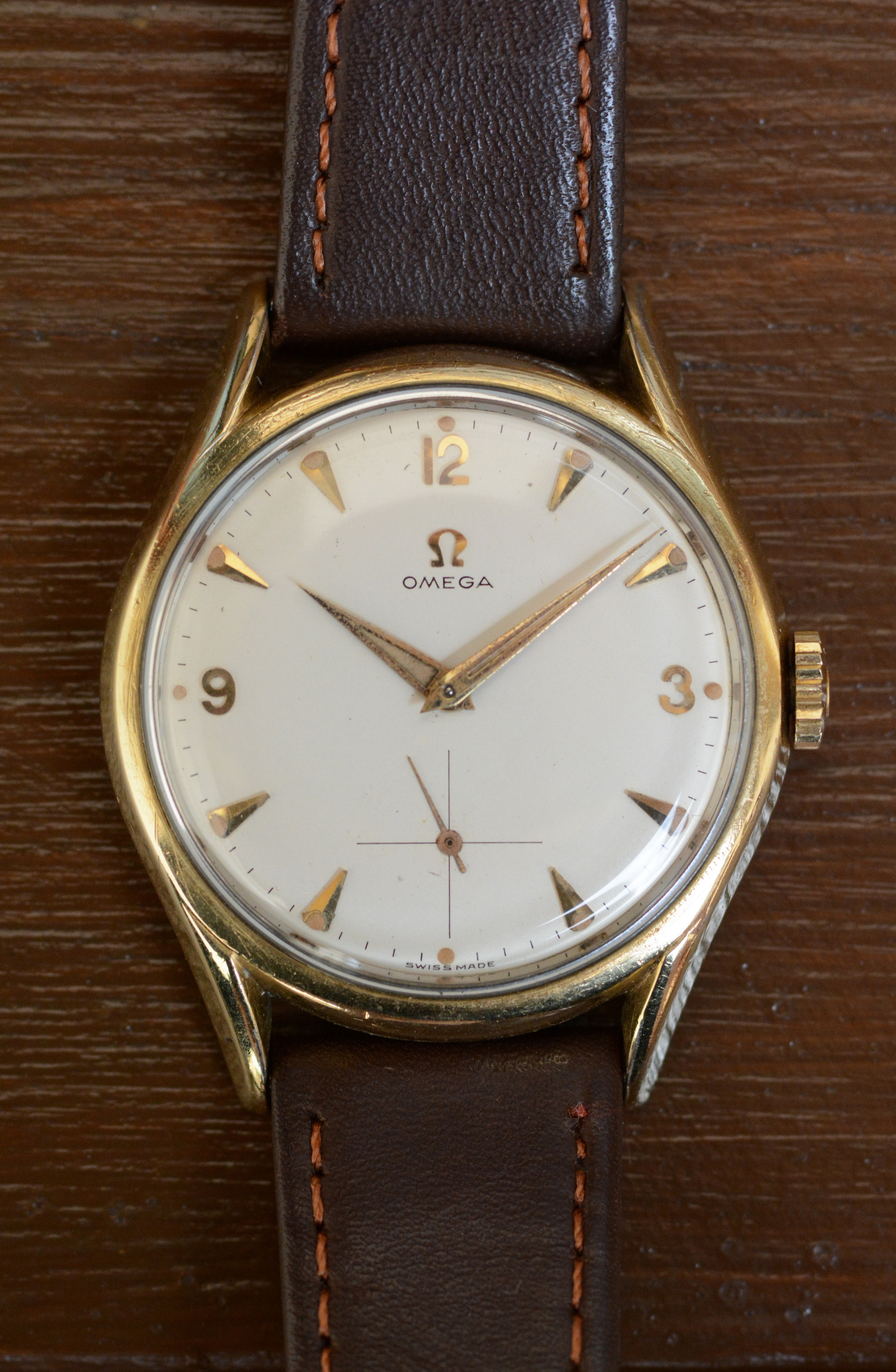
This Omega vintage timepiece represents the pinnacle of mid-century Swiss horological design, often referred to by collectors as a 'Calatrava-style' dress watch due to its elegant, time-only configuration and balanced proportions. Produced during the early 1950s, this specific model showcases the transition from the utilitarian designs of the 1940s to the more refined, expressive aesthetics of the post-war era. It features a stunning cream-white dial characterized by 'Explorer-style' Arabic numerals at the 3, 9, and 12 positions, interspersed with faceted arrowhead markers that catch the light with exceptional brilliance. The sub-seconds register at 6 o'clock provides a cross-hair detail that adds a touch of technical sophistication to an otherwise minimalist layout. Collectors prize these models for their wearable dimensions and the legendary reliability of Omega’s manual-wind movements from this period. It is a watch that exists as a testament to Omega's era of dominance in chronometry and daily-wear elegance, predating the formal branding of the Seamaster and Constellation lines as we know them today. For the discerning investor, it represents a high-entry-level vintage asset that combines historical pedigree with a timeless aesthetic that remains highly relevant in modern sartorial circles.
Technical Architecture
The architecture of this Omega is centered around its robust manual-wind caliber, most likely a member of the 30mm family (such as the Calibre 265 or 266), which is widely regarded as one of the finest hand-wound movements ever produced for mass consumption. These movements are celebrated for their simplicity, ease of service, and chronometric potential. The case construction features a 'Gold Cap' or heavy gold-filled technique, where a thick layer of 14k or 18k gold is mechanically bonded to a stainless steel core, providing the luxurious appearance of solid gold with significantly increased structural integrity. The lugs are elegantly tapered and slightly curved to ensure a flush fit against the wrist, a hallmark of Omega's ergonomic focus during this period. The dial is protected by a domed Hesalite acrylic crystal, which provides a warm, vintage distortion at the edges that sapphire cannot replicate. The crown is typically signed with the Omega logo, though it maintains a low profile to preserve the dress watch silhouette. Water resistance is minimal by modern standards, as this was engineered for formal environments rather than sporting pursuits, relying on a snap-back or early screw-down case design to protect the movement from dust and humidity.
Historical Context
Introduced in the early 1950s, this reference sits at a critical juncture in Omega’s history. Following the success of their military-spec watches during World War II (the 'Dirty Dozen' era), Omega sought to pivot toward a civilian market hungry for luxury and refinement. This model served as a bridge, utilizing the mechanical advancements of war-time production—specifically the high-shock resistance and antimagnetic properties—within a case design suitable for the emerging professional class. It predates the explosion of the 'Tool Watch' era of the late 50s, representing a time when a single watch was expected to be a lifetime companion for all occasions. The use of the '3-9-12' dial layout with arrowhead markers was a popular design language of the time, later influencing the aesthetics of the early Seamasters and even the first Railmaster models. This period established Omega as a primary rival to Patek Philippe and Rolex in the dress watch category, long before the brand became synonymous with the lunar missions. Owning this piece is essentially owning a chapter of the foundation upon which Omega’s modern reputation for precision and elegance was built.
Market Intelligence
The market for mid-century vintage Omega dress watches remains one of the most liquid and stable segments of the horological secondary market. Unlike the volatile 'hype' watches of the modern era, these vintage references have shown a consistent, slow-growth trajectory over the last two decades. Demand is driven by a global collector base that appreciates the value-to-prestige ratio; few brands offer this level of historical importance for under $2,000. Supply is moderate, but finding examples with original, non-refinished dials and sharp case geometry is becoming increasingly difficult, which puts a premium on well-preserved specimens like the one pictured. The 'Gold Cap' models occupy a unique niche, offering the aesthetic of a solid gold watch at a fraction of the cost, making them highly attractive to entry-level vintage enthusiasts. From an investment perspective, these watches act as a 'store of value.' While they may not see the 300% spikes associated with limited edition chronographs, they are highly resistant to market downturns due to their classic appeal and the global strength of the Omega brand. They are considered an essential 'blue chip' component of any diversified vintage watch portfolio.
.jpg.jpg)