WatchIQ
Longines
Longines Flagship Automatic (Vintage Ref. 3418)
Market Estimate
~$850
Specifications
Market Range
Longines
Longines Flagship Automatic (Vintage Ref. 3418)
Market Estimate ~ $850
Market Range
Specifications
Executive Overview
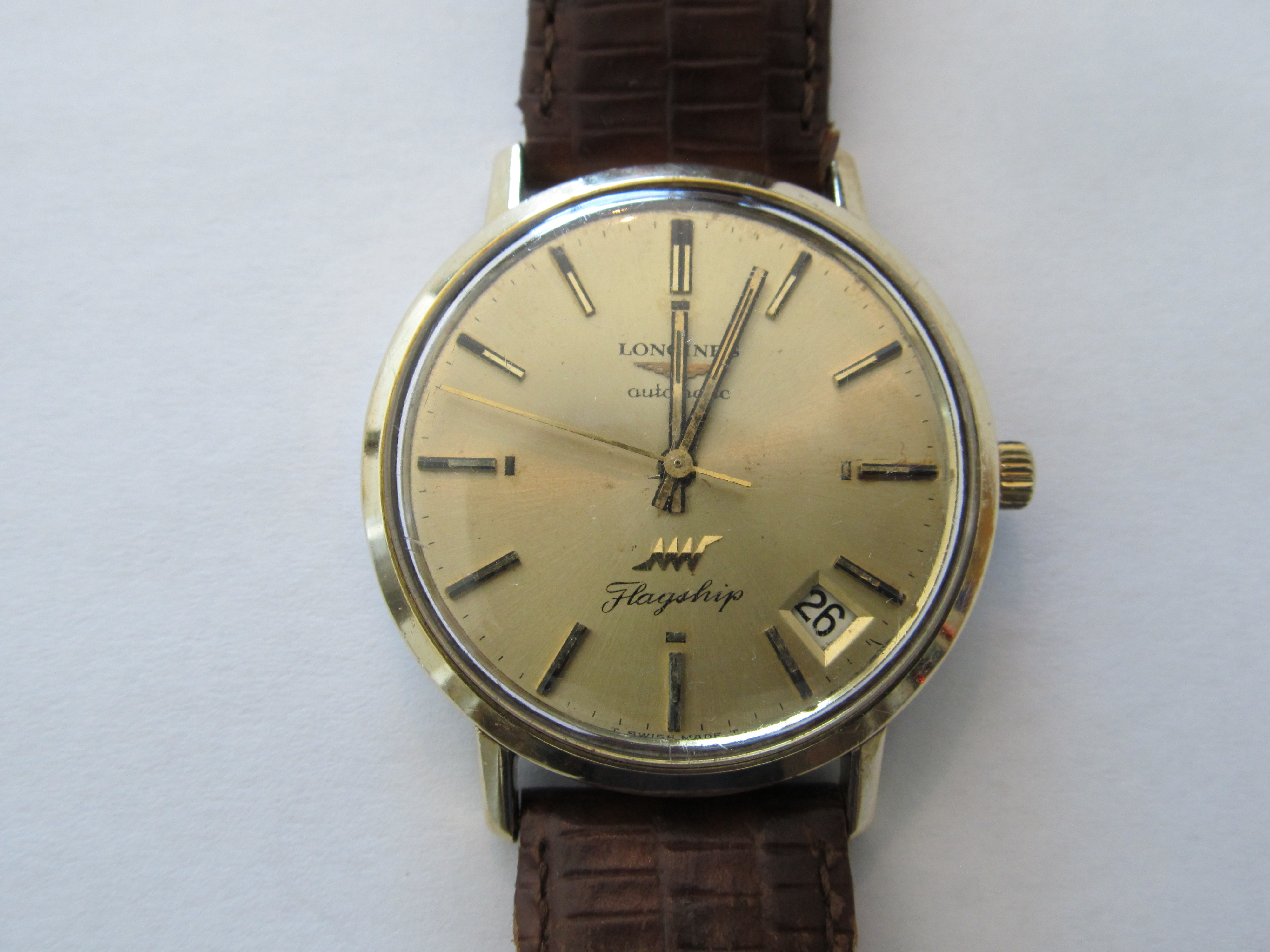
The Longines Flagship represents one of the most enduring legacies in the history of Swiss watchmaking. Originally launched in 1957, the Flagship collection was designed to embody the brand's commitment to elegance, precision, and technical prowess. This specific vintage iteration, dating from the mid-1960s, features the iconic 'Flagship' script and the distinctive stylized wave or ship logo on the dial, a hallmark of the line's maritime-inspired identity. Collectors prize these models for their clean, mid-century aesthetic and the high-grade mechanical movements that Longines was producing during its golden era. Unlike modern reinterpretations, this original vintage piece captures a specific moment in horological history when Longines was a direct competitor to the likes of Omega and Rolex in terms of movement finishing and chronometric performance. The champagne sunburst dial, applied baton markers, and the unique date placement at 4:30 or 3 o'clock positions (depending on the specific caliber) make it a versatile dress watch that transcends temporary trends. It exists as a testament to the era of 'understated luxury,' where the value was found in the engineering and the refinement of the profile rather than overt branding. For the discerning collector, the Flagship is not just a watch, but a piece of industrial art that remains as wearable today as it was sixty years ago.
Technical Architecture
The technical foundation of this Longines Flagship is centered around a high-frequency automatic movement, likely from the esteemed 340 or 350 caliber series. These movements were renowned for their innovative 'perimeter rotor' or offset oscillating weight designs, which allowed for a thinner case profile while maintaining robust power reserves. The case construction typically utilizes a gold-plated brass or stainless steel mid-case with a screw-down or pressure-fit case back, often featuring the famous gold and enamel 'caravel' ship medallion. The crystal is a domed hesaltite (acrylic), which provides a warm vintage distortion and can be easily polished. The dial architecture is particularly sophisticated, featuring a sunburst finish that radiates light from the center, complemented by faceted, applied indices that provide depth and legibility. The date window is integrated seamlessly, often with a metallic frame to match the hour markers. Water resistance by modern standards is negligible, as these were designed as elegant dress watches, but the original gaskets and crown sealing were sufficient for daily environmental protection. The lugs are tapered and drilled, allowing for easy strap changes, though it is most traditionally paired with a high-quality lizard or calfskin leather strap to emphasize its formal character.
Historical Context
When the Flagship was introduced in 1957, it was positioned as the pinnacle of the Longines catalog, hence the name. At the time, Longines was an independent manufacture with a reputation for creating some of the finest chronographs and time-only movements in Switzerland. The Flagship was the brand's answer to the growing demand for reliable, automatic chronometers that could transition from the boardroom to social engagements. Throughout the 1960s, the model evolved to include various date complications and movement upgrades, reflecting the rapid pace of horological innovation during the Space Age. It sat alongside the 'Conquest' line as the brand's primary offerings. This specific model represents the transition into more modern, streamlined aesthetics that defined the mid-60s, moving away from the heavier lugs of the 1950s toward a more integrated, sleek silhouette. Historically, the Flagship is also significant for its role in establishing Longines' global distribution network, as it became one of their most exported and recognized models worldwide, solidifying the 'winged hourglass' logo as a symbol of quality across continents.
Market Intelligence
From an investment and market perspective, the vintage Longines Flagship is currently positioned in a 'sweet spot' for collectors. While it does not command the astronomical prices of vintage Patek Philippe or specific Rolex sports models, it offers significantly better value-for-money in terms of movement quality and brand heritage. The secondary market has seen a steady increase in demand for 'neo-vintage' and true vintage dress watches as tastes shift away from oversized sport watches. Supply for well-preserved examples is tightening, as many of these pieces were worn daily and suffered from dial corrosion or over-polishing. A specimen with a clean dial and an unpolished case back medallion is considered highly liquid and desirable. Long-term value retention for the Flagship is supported by Longines' own 'Heritage' collection, which frequently releases re-editions of these classic models, thereby keeping the original designs relevant to a new generation of buyers. As an asset, it represents a low-volatility entry point into blue-chip vintage collecting, with a strong floor price supported by the intrinsic value of the brand name and the mechanical craftsmanship of the era.