WatchIQ
Junghans
Junghans Phoenix Solar
Market Estimate
~$250
Specifications
Market Range
Junghans
Junghans Phoenix Solar
Market Estimate ~ $250
Market Range
Specifications
Executive Overview
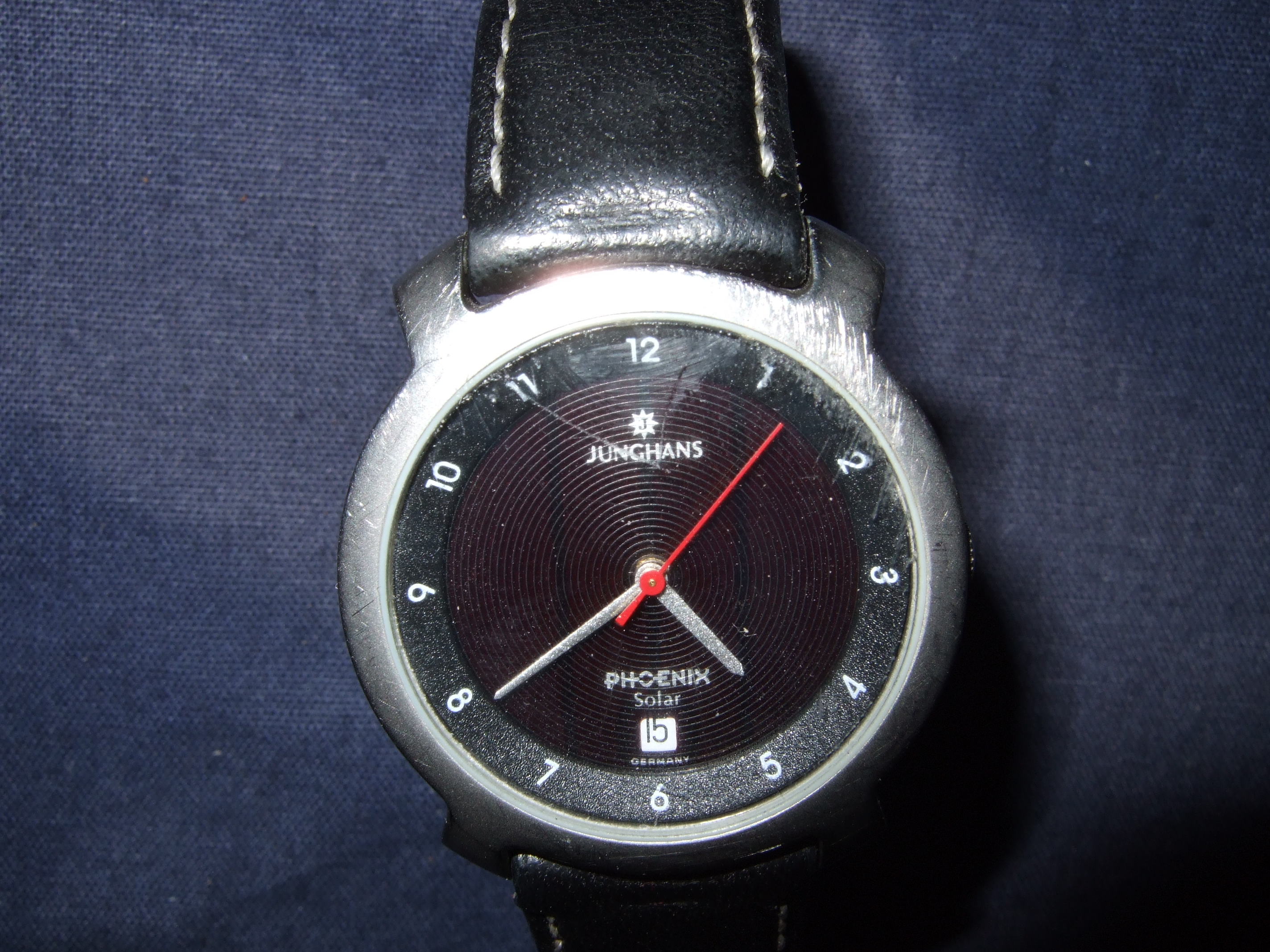
The Junghans Phoenix Solar represents a pivotal era in German horology where traditional manufacturing met the burgeoning demand for sustainable, high-technology timekeeping. As a brand synonymous with precision and Bauhaus-inspired design, Junghans utilized the Phoenix collection to showcase their prowess in light-driven energy conversion. This specific model is a testament to the brand's 'form follows function' philosophy, featuring a distinctive solar cell integrated directly into the dial. The concentric circular guilloché pattern on the central solar panel is not merely decorative; it is engineered to maximize light absorption while maintaining a sophisticated aesthetic. Collectors value the Phoenix Solar as an artifact of the 1990s quartz evolution, representing a time when European brands were aggressively competing with Japanese giants like Seiko and Citizen in the solar sector. It is a watch that appeals to those who appreciate the intersection of industrial design and early eco-conscious engineering. While it lacks the high-luxury cachet of the Max Bill series, the Phoenix Solar holds a respected position in the secondary market for its reliability, distinctive red seconds hand contrast, and its role in the legacy of Junghans' technical innovation.
Technical Architecture
At the heart of the Junghans Phoenix Solar is a sophisticated solar-quartz movement designed for longevity and minimal maintenance. The watch utilizes a high-efficiency solar cell located beneath the translucent central dial, which converts both natural and artificial light into electrical energy stored in a secondary rechargeable battery. This eliminates the need for frequent battery replacements, a hallmark of Junghans' commitment to environmental efficiency. The case is constructed from brushed stainless steel, featuring integrated lugs that flow seamlessly into the strap, providing a robust yet ergonomic profile. The dial is divided into two distinct zones: an outer matte black ring featuring printed Arabic numerals for hours, and a central solar-active zone with a radial texture. A date aperture is positioned at 6 o'clock, maintaining the dial's vertical symmetry. The crystal is typically a hardened mineral glass, chosen for its clarity and impact resistance. Water resistance for this model was standard for daily wear, usually rated at 3 to 5 bar, ensuring protection against splashes and rain. The hands are treated with luminous material for low-light legibility, while the vibrant red seconds hand provides a necessary pop of color against the monochromatic industrial backdrop.
Historical Context
Junghans has a storied history dating back to 1861 in Schramberg, Germany, and has often been at the forefront of timekeeping technology, including the world's first radio-controlled wristwatch. The Phoenix Solar emerged in the mid-1990s, a period when the watch industry was stabilizing after the quartz crisis and began focusing on alternative power sources. Junghans was a pioneer in this field, having introduced solar-powered clocks as early as the 1970s. The Phoenix collection was part of a broader push to democratize high-tech German engineering, offering a reliable, maintenance-free timepiece to the professional class. It sits historically between the classic mechanical heritage of the brand and the high-tech 'Mega' radio-controlled watches that would define Junghans' modern identity. The design language of the Phoenix reflects the transitional aesthetic of the 90s—moving away from the ultra-thin profiles of the 80s toward more substantial, tactile, and tool-like case shapes. It serves as a bridge for the brand, proving that they could master the electronics of solar power without sacrificing the clean, legible design codes that made their earlier collaborations with Max Bill so famous.
Market Intelligence
From an investment and market perspective, the Junghans Phoenix Solar is classified as a 'niche enthusiast' asset. It does not command the high premiums associated with the brand's mechanical chronographs or limited edition Bauhaus reissues, but it maintains a steady demand among collectors of vintage solar and German technology. The secondary market for these pieces is characterized by low volatility and moderate liquidity; they are often sought after by 'tech-vintage' collectors who value the specific 90s aesthetic. Supply is relatively scarce in 'New Old Stock' or mint condition, as these were primarily used as daily 'workhorse' watches, leading to significant wear on the case and crystals over time. Value retention is stable, with prices largely dictated by the health of the internal rechargeable cell and the integrity of the solar panel. While not a high-growth asset, the Phoenix Solar benefits from the overall rising prestige of the Junghans brand name globally. For a collector, the primary risk involves the aging of the solar components, but as a piece of German industrial history, it offers a high 'satisfaction-per-dollar' ratio for those looking to enter the world of independent German watchmaking at an accessible price point.
.JPG.JPG)