WatchIQ

Gallet
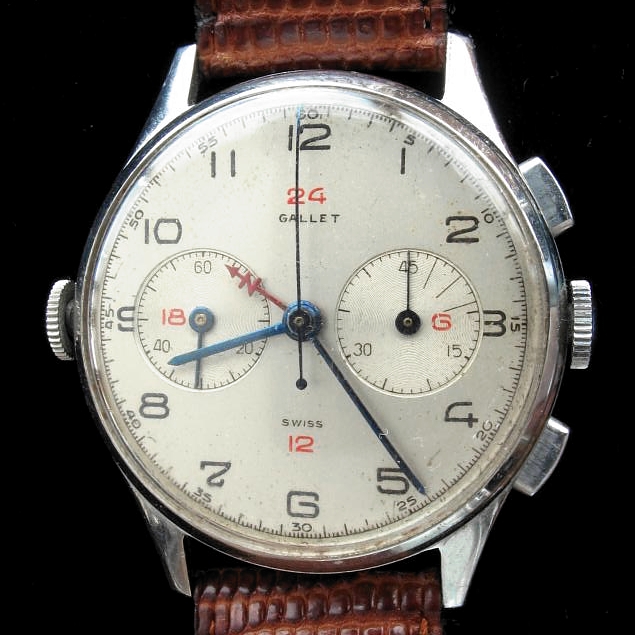
Gallet MultiChron 12 'Clamshell' Chronograph
Market Estimate
~$8,500
Specifications
Market Range
Gallet
Gallet MultiChron 12 'Clamshell' Chronograph
Market Estimate ~ $8,500
Market Range
Specifications
Executive Overview
The Gallet MultiChron 12 'Clamshell' represents a pinnacle of mid-century tool watch engineering, standing as one of the most historically significant chronographs in the world of vintage horology. Distinguished by its innovative four-screw case design, this model was the world’s first water-resistant chronograph, earning it the 'Clamshell' moniker among seasoned collectors. This specific iteration features a stunning black 'snail' dial, characterized by its concentric tachymeter and telemeter scales, which allowed professionals—from doctors to military officers—to perform complex calculations on the fly. Gallet, as the world’s oldest clock and watchmaking house, utilized its vast expertise to create a timepiece that was as robust as it was precise. Today, the MultiChron 12 is highly coveted not just for its aesthetic appeal, but for its role as a precursor to the modern professional sports watch. Collectors prize these models for their honest utility, historical pedigree, and the exceptional craftsmanship of their Swiss-made movements. In an era of mass-produced luxury, the Gallet Clamshell serves as a reminder of a time when watches were essential instruments of survival and scientific inquiry, making it a cornerstone for any serious horological portfolio.
Technical Architecture
The engineering of the MultiChron 12 is centered around the revolutionary 'Clamshell' case, patented by Gallet in the late 1930s. Unlike traditional screw-down or snap-back cases, the Clamshell utilizes four screws located on the underside of the lugs to compress a gasket between the upper and lower case sections, creating a hermetic seal. This specific model is housed in a stainless steel case with a diameter of approximately 34.5mm to 36mm, featuring a polished bezel and brushed lug surfaces. Under the acrylic crystal lies a complex multi-scale dial, often featuring a 'snail' tachymeter in the center for measuring speeds and a telemeter scale on the outer track for calculating distance based on the speed of sound. At its heart beats the legendary Excelsior Park 40 (or occasionally a Valjoux 72 in later variants), a high-grade manual-wind column-wheel chronograph movement. The EP40 is renowned for its smooth pusher engagement and longevity, featuring a 17-jewel construction and a power reserve of approximately 40 hours. The waterproof nature of the case is further reinforced by the unique 'pump' pushers, which were designed to maintain integrity even under pressure, a feat that set Gallet apart from its contemporaries during the mid-1940s.
Historical Context
Gallet’s history dates back to 1466, but its 20th-century contributions to the chronograph are perhaps its most enduring legacy. The MultiChron 12 was introduced during an era of rapid technological advancement fueled by the requirements of World War II. While many chronographs of the time were fragile and susceptible to moisture, Gallet’s development of the waterproof Clamshell case in 1936 revolutionized the industry. This specific model, likely produced between 1940 and 1950, represents the maturation of that technology. It was the preferred choice for the Swiss Air Force and various Allied military branches, as well as professionals in the fields of aviation and racing. The MultiChron 12 eventually paved the way for the later Flight Officer and Flying Officer models, which were famously worn by President Harry S. Truman. In the broader context of watchmaking, the MultiChron series proved that a high-complication timepiece could also be a rugged, everyday tool, influencing the design language of iconic watches from brands like Heuer and Breitling that would follow decades later. Its survival today in such crisp condition is a testament to the foresight of Gallet’s engineers in prioritizing environmental protection for the movement.
Market Intelligence
From an investment perspective, the Gallet MultiChron 12 is currently in a 'sweet spot' of market appreciation. While brands like Rolex and Patek Philippe often dominate the headlines, savvy collectors have increasingly turned their attention to Gallet for its superior movement quality and genuine historical 'firsts.' The rarity of the black 'snail' dial variants significantly boosts its desirability; these dials are far less common than the standard silvered versions and often command a 30-50% premium on the secondary market. Liquidity for high-quality Gallet chronographs is remarkably high within the vintage community, with examples often selling quickly at specialized auctions or through high-end vintage dealers. Supply is naturally capped, as many of these watches were lost to the rigors of professional use or have suffered from poor service over the last 80 years. We observe a steady upward trajectory in value retention, particularly for examples that retain their original case geometry and unpolished lug screws. As the market continues to prioritize 'tool-watch' authenticity and mechanical pedigree, the MultiChron 12 stands as a low-volatility asset with significant long-term upside potential, particularly as the brand’s deep archives become better known to the general public.