WatchIQ
Gallet
Gallet Flying Officer Chronograph (Third Generation)
Market Estimate
~$7,500
Specifications
Market Range
Gallet
Gallet Flying Officer Chronograph (Third Generation)
Market Estimate ~ $7,500
Market Range
Specifications
Executive Overview
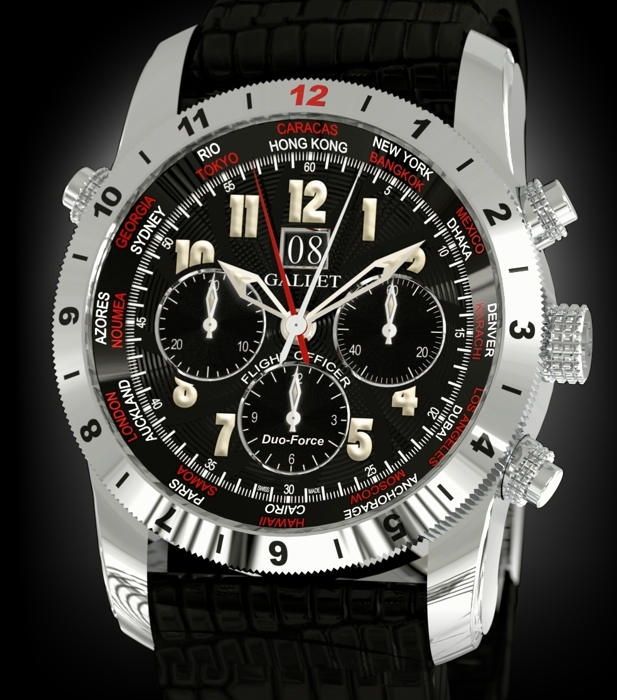
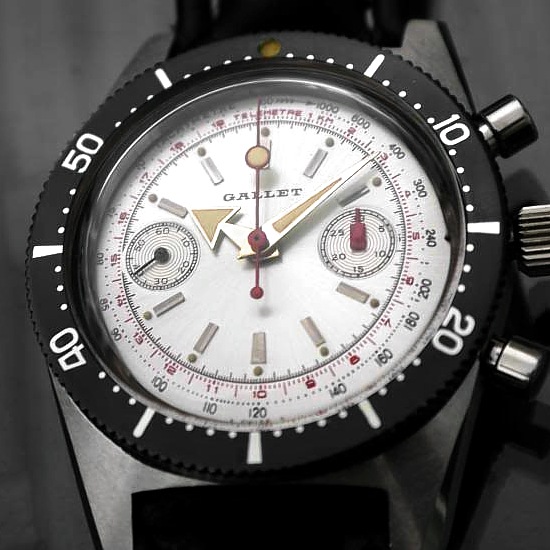
The Gallet Flying Officer Chronograph is a cornerstone of mid-century horological engineering, originally commissioned by Senator Harry S. Truman for United States Army Air Forces pilots during World War II. This specific third-generation execution, characterized by its robust stainless steel case and rotating 12-hour bezel, represents the pinnacle of Gallet’s functionalist design philosophy. Unlike standard chronographs of the era, the Flying Officer was designed as a true tool for aviators, featuring a sophisticated world time calculation system integrated into the dial and bezel. This model is highly coveted by collectors not just for its military lineage, but for its exceptional legibility and the prestige of the Gallet name—the world's oldest watchmaking house. The combination of a silvered sunburst dial, recessed registers, and the iconic 'Big Arrow' hour hand creates a visual profile that is simultaneously aggressive and elegant. It occupies a unique niche in the market, appealing to military historians and vintage chronograph enthusiasts who value technical substance over mainstream brand recognition. As vintage Gallet pieces continue to gain traction in the secondary market, the Flying Officer remains the most essential acquisition for any serious student of pilot watch history.
Technical Architecture
At the heart of this Flying Officer is the venerable Valjoux 7733 manual-wind chronograph movement, a caliber renowned for its reliability and serviceability. The architecture of the watch is defined by its 37mm to 38mm stainless steel 'cushion-style' case, which provides a substantial wrist presence while maintaining the ergonomic standards of the late 1960s. The dial is a masterpiece of information density, featuring a dual-register layout with a 30-minute counter at 3 o'clock and running seconds at 9 o'clock. Surrounding the main dial is a telemeter scale in red and a tachymeter scale, allowing the pilot to calculate distance based on sound and speed over a fixed distance. The bidirectional rotating bezel is finished in black anodized aluminum, marked with 12-hour increments to allow the wearer to track a second time zone—a critical feature for transcontinental flight. The crystal is a high-domed hesalyte acrylic, which offers the characteristic warmth of vintage pieces and remains shatter-resistant under cockpit pressure changes. The pump-style pushers are crisp in their actuation, engaging the cam-lever system of the movement with a tactile mechanical feedback that defines the era of manual chronographs.
Historical Context
Gallet’s history spans over 500 years, but the Flying Officer is perhaps its most significant contribution to the 20th century. Introduced in 1939, the model was the first wristwatch capable of displaying time in all 24 zones of the world, achieved through the synchronization of the rotating bezel with city names on the dial (in earlier versions) or simplified hour offsets in later iterations. This specific model reflects the evolution of the line into the late 1960s, where the design shifted toward a more utilitarian and sporty aesthetic to compete with the likes of the Heuer Autavia and the Breitling Navitimer. The Flying Officer gained legendary status when it was confirmed that Harry S. Truman wore one during his presidency, cementing Gallet’s reputation among the American political and military elite. This generation represents the final era of mechanical dominance before the 'Quartz Crisis' reshaped the industry, making it a definitive snapshot of Swiss tool-watch excellence. It serves as a bridge between the early aviation instruments of the 1940s and the modern professional chronographs of today, maintaining a design language that has remained remarkably influential across the decades.
Market Intelligence
The market for vintage Gallet chronographs has seen a significant upward trajectory over the last five years, moving from an 'insider's secret' to a mainstream vintage staple. The Flying Officer, in particular, benefits from high liquidity due to its recognizable silhouette and historical importance. Supply is inherently limited; while not as scarce as the 'Jim Clark' Multichron 12, high-quality examples of the third-generation Flying Officer with original bezels and unpolished cases are increasingly difficult to source. Collector interest is driven by the 'value-play' narrative—Gallet offers the same movement quality and historical depth as early Rolex or Breitling models but at a more accessible price point. However, that gap is closing. Secondary market behavior shows that 'Full Set' examples or those with documented provenance command significant premiums. The brand strength of Gallet remains robust among purists, and the long-term value retention is categorized as strong, as the watch appeals to both the military memorabilia market and the luxury horology sector. Investors should look for dial cleanliness and the presence of the original red telemeter markings, as these are the primary drivers of valuation in the current climate.