WatchIQ
Bulova
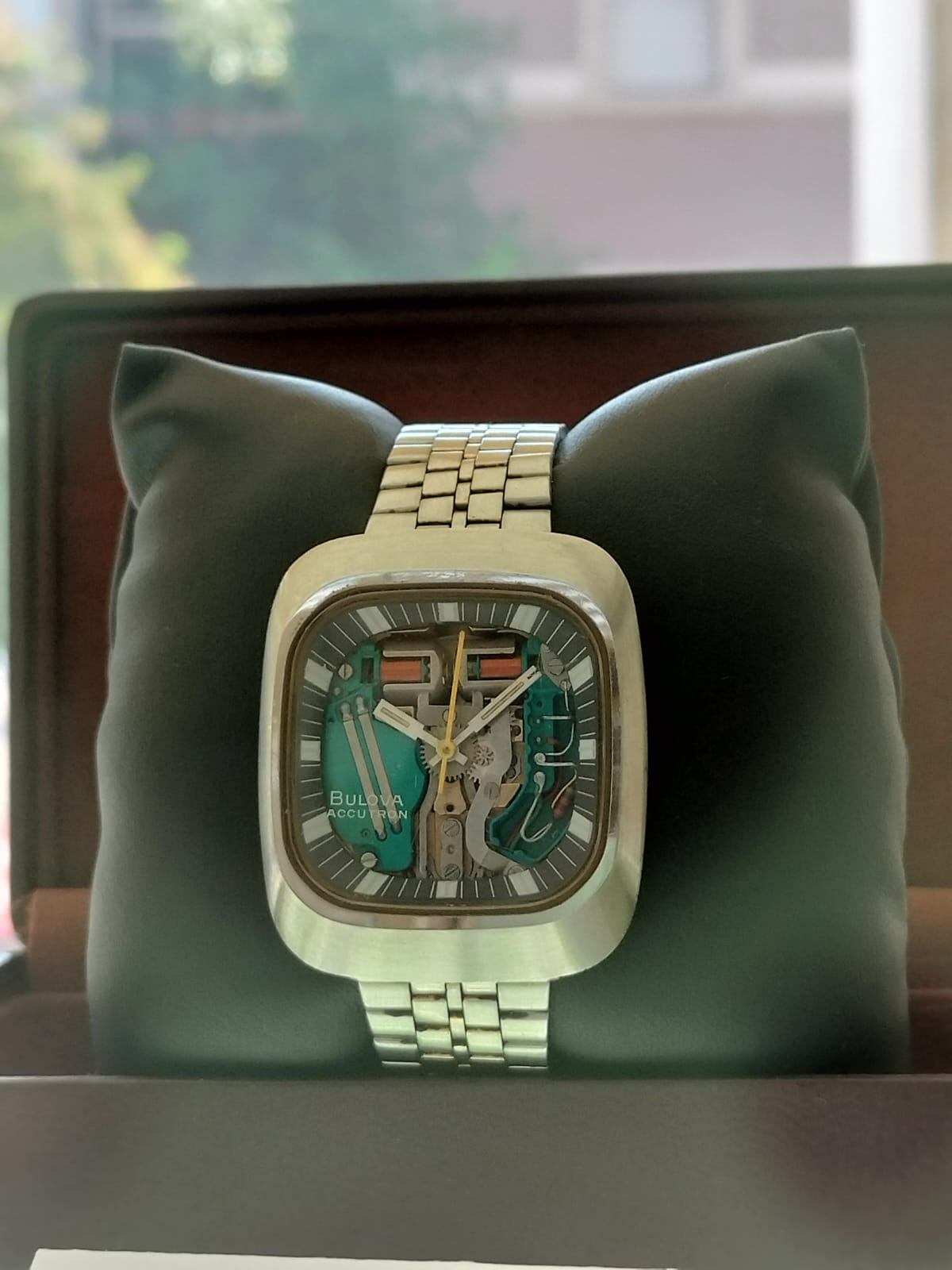
Bulova Accutron Spaceview 'TV Screen' Cushion Case
Market Estimate
~$1,250
Specifications
Market Range
Bulova
Bulova Accutron Spaceview 'TV Screen' Cushion Case
Market Estimate ~ $1,250
Market Range
Specifications
Executive Overview
The Bulova Accutron Spaceview remains one of the most significant horological milestones of the 20th century, representing a bridge between traditional mechanical watchmaking and the quartz revolution. This specific 'TV Screen' cushion case variant is a quintessential example of 1970s futurism. Unlike standard watches of its era, the Spaceview lacks a traditional dial, instead exposing the intricate copper coils, green circuit board, and vibrating tuning fork that define its movement. This design was originally intended as a salesman’s demonstrator tool to showcase the revolutionary electronic technology, but it became so popular with the public that Bulova transitioned it into a production model. Collectors prize the Spaceview not just for its aesthetic transparency, but for its unique 'humming' sound—a byproduct of the 360Hz vibration of the tuning fork—and the mesmerizingly smooth sweeping seconds hand that rivals modern high-end mechanical movements. In a world of ticking quartz and oscillating balances, the Accutron stands alone as a testament to American engineering prowess and a mid-century vision of the future. The cushion-shaped case provides a substantial wrist presence that feels contemporary yet distinctly vintage, making it a cornerstone for any serious collection focusing on electronic horology or iconic industrial design.
Technical Architecture
At the heart of this timepiece is the legendary Caliber 214, the world’s first fully electronic watch movement. Engineering-wise, the Accutron replaced the traditional balance wheel with a 360Hz tuning fork powered by a battery-activated electromagnetic circuit. This architecture allows for a degree of precision that was unheard of in the 1960s and 70s, guaranteeing accuracy within two seconds per day. The 'TV Screen' case is constructed from brushed stainless steel, featuring a wide, rounded rectangular bezel that frames the deconstructed movement. A critical technical detail of the Caliber 214 is the absence of a traditional side-mounted crown; instead, the time-setting mechanism is located on the caseback via a fold-out D-ring, maintaining the sleek, symmetrical profile of the cushion case. The crystal is typically a high-domed acrylic, often featuring the white printed hour markers and the Bulova Accutron logo on the underside to create a sense of depth over the exposed components. The movement itself is a marvel of miniaturization, featuring two large electromagnetic coils and a transistorized circuit that remains easily identifiable by its signature green substrate. This architectural transparency serves both a functional and aesthetic purpose, turning the engine of the watch into its own decoration.
Historical Context
Launched in October 1960, the Accutron was the result of eight years of research led by Max Hetzel. It was a disruptive technology that eventually saw the Accutron movement utilized in cockpit instruments for the NASA Gemini and Apollo programs due to its resistance to extreme temperatures and high G-forces. By the early 1970s, the design language of the Accutron evolved from the classic round 'Alpha' cases into the more experimental shapes favored by the era’s designers. The 'TV Screen' cushion case seen here represents the peak of this aesthetic evolution, reflecting the cultural obsession with television and space-age geometry. While the quartz movement would eventually displace the tuning fork in the mid-1970s due to lower production costs, the Accutron remains the superior historical artifact because it represents a complete rethinking of how time is measured. This model sits at the crossroads of the brand's history, marking the final golden age of Bulova's American-led innovation before the industry shifted toward Japanese quartz dominance. It is a symbol of an era when Bulova was the most technologically advanced watchmaker in the world, trusted by both the U.S. government and the general public for its unprecedented reliability.
Market Intelligence
The market for vintage Bulova Accutron Spaceview models has seen a significant resurgence over the last decade, driven by a growing appreciation for 'transitional' horology. The 'TV Screen' cushion case is particularly desirable because it is less common than the standard round variants and offers a more robust, modern wearing experience. From an investment perspective, the Spaceview is a 'blue-chip' vintage entry-point; while prices are accessible compared to Swiss mechanical icons, they show consistent year-over-year appreciation. The primary driver of value for this model is the condition and originality of the movement components. many Spaceviews were 'conversions' (standard Accutrons with the dials removed), but factory-original Spaceview references command a premium. Secondary market liquidity is high, as there is a dedicated global community of Accutron enthusiasts and specialized watchmakers who can service these unique movements. The brand strength of Bulova, now owned by Citizen, remains high, and their recent 'Accutron' brand relaunch has only served to increase interest in the original 1960s and 70s models. Collectors should look for examples with clean coils and no signs of battery leakage, as these are the most critical factors for long-term value retention.